THE BOOK OF WAR (BETA)
¶ Wars
¶ What are they?
A war's main purpose is to conclude or enhance conflicts and allow some interesting story telling. Wars are supposed to be large scale events that take place over a decent period of time (weeks to months.) The flashy part of a war, the fighting, is what we will go over here, but it is also encouraged to do more RP things such as sanctions.
¶ Propaganda
Propaganda is an important tool in any waring nation's kit.
Frequently with propaganda you are not telling the (full) truth.
To help staff keep track of what exactly is going on, it is requested that you inform staff when you send fabricated, edited, and/or misleading messages/announcements, stating what you have changed (or created) and what the original source use to say, if it existed.
This information can be sent in either your side's private war channel, or in a lore ticket.
Overall however try to avoid sending too many (unique) faked/edited messages, both because this makes you seem dishonest which may actually hurt you in the war, and also to avoid things spiraling out of control in general.
EXAMPLE
The fierce dictator ruling over XYZ has stated that any land who even hints at not aligning with the goals of XYZ will be crushed by their might. Join our side so that YOU can help quell this threat!
[INSERT (FAKED) IMAGE OF MESSAGE]
Propaganda (or similar misinformation) should not involve IRL (or "meta") actions/information.
For example: "you should join our side because XYZ said they would Doxx anyone who stood up to them." is not allowed because it referenses an IRL thing (doxxing). If the statement is true, this should be reported to staff instead of used as a reason to rally people for your side of a war.
¶ During War
During a war 2 major things happen:
- The area around lands at war becomes Lawless (the lands themselves stay Protected)
This should help make areas at war feel more dangerous, while not making the area completely uninhabitable while there's no active fighting. - Upkeep is increased by 1.5x
This makes wars not only costly in gear but also raw money. This is to "simulate" the fact that was is expensive, treat it as extra work being put into maintaining structures damaged by conflict.
The upkeep change mentioned will not apply until after custom upkeep is implemented.
¶ Starting a War
¶ Types of War
There are 2 main types of war, inter-group (group being a land, nation, or even alliance) conflicts (think typical war) and intra-group conflicts (think civil war).
Inter-group conflicts take place between 2 groups that are distinct from each other, such as different lands or nations.
These types of wars are pretty simple, with each side starting out with the territory they already own.
Intra-group conflicts (such as civil wars) take place when one group splits into 2 or more pieces, resulting in the ownership of the territory in that group also being split. If we take for example a land where one half really loves turtles, but the other half wants to kill all turtles, then that could end up in a civil war (do not actually use this reason) where each side gets half of the land as their starting territory, and defines their own core district (more info on Districts further down). Using Hillbilly as an example, the pro turtle side could get the Green and Pink districts, with the anti turtle side getting the rest.
You cannot declare war on a specific land in a nation. You can attempt to come to agreement with a nation to remove the land or not intervine, but as long as a land is in a nation it's nation can intervine.
¶ Giving an out
Not every land/nation is capable of going to war so it's nice to give them a way out of the war. The exact details will vary from war to war, but some examples could be a monetary payment (such as to buy land you believe you own but they occupy) or the removal of an outpost. Typically you'd want this to basically be whatever resolves the source of the conflict in the first place.
¶ Districts
All relevant lands in a war will be split into districts by players or staff (see Declaring War), primarily based on things like distinct areas, such as a castle inside of a land. Each land will also have a "core district", which is effectively the district that needs to be captured to capture the land.
In a Nation vs Nation war there will be around 4-6 districts per land (depending on the exact layout of the land), while in Land vs Land war districts would be much denser (up to 10 depending on layout of the land) to make up for the lack of multiple lands.
¶ Example - Hillbilly
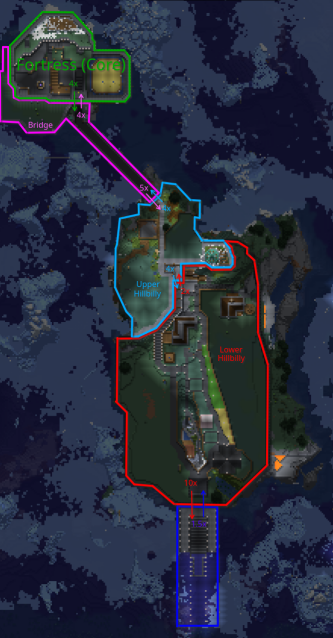
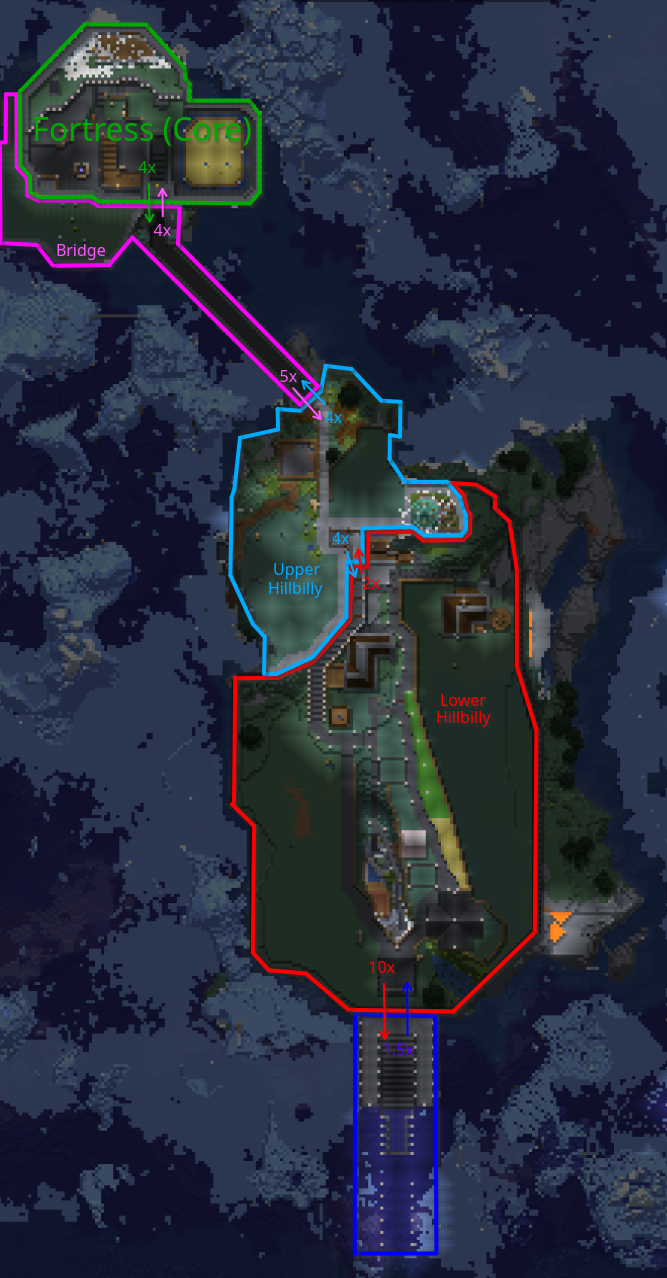
(Full size image at bottom of page)
In this example Hillbilly is split into 5 districts.
The Blue district is the Docks.
The Red district is the "Lower Hillbilly"
The Light Blue district is the "Upper Hillbilly"
The Pink district is the Bridge
The Green district is the Fortress - CORE DISTRICT
Districts CAN be 3 dimensional, A 2d map of Hillbilly is being used here for ease of demonstration.
¶ Battles
Battles are scheduled fights where one side (the "Attackers") attempt to capture one or more districts controlled by the other side (the "Defenders").
Battles last up to 2 hours (excluding downtime between attacks), with attacks happening at one district at a time. If the defenders manage to prevent an attacked district from being captured for 1 hour the attackers are "repelled", ending the battle early. Otherwise the battle ends after the 2 hours run out, the attackers stop advancing (for any reason), or all districts in the land being attacked are captured. If the attackers capture a district, then can then choose to move onto another district, or stop advancing in the current battle.
¶ Points
Attackers
Attackers get points for attacking a district, which means doing one of the following:
Defender Killed: +2 Points
Contested hold: +1 Point/Minute
Uncontested hold: +5 Points/Minute
A "hold" is when there are more attackers in a district than defenders.
An uncontested hold is when there are 4 or more attackers for every defender.
Defenders
Defenders can remove points by defending their district, though the requirements for them are a bit steeper.
(Note: Subtracting points means removing points from the attackers progress, points cannot drop under 0)
Attacker Killed: -2 Points.
3-4 Defenders per Attacker: -1 Point/Minute
5+ Defenders per Attacker: -5 Points/Minute
Defenders basically get their own sort of "hold" if they manage to defend their district well enough
The number of points needed to capture a district is based on a few factors, such as how defensible the district is.
Using Hillbilly as an example:
Capturing the Blue district would be super easy since it has no real defensive structures.
If you wanted to go for the Green district you could attempt to take it right away, but it would be extremely difficult (if not near impossible), so you need to do something to make it easier first.
¶ Multipliers
Districts can give a multiplier to the points earned for holds, so taking the Pink district before the Green district could reward something like a 5x multiplier for holds in the Green district, making capturing it significantly easier.
When multiple multipliers apply to a district, their value is added meaning 2x and 3x = 5x, not 6x.
Mutlipliers also only apply to ATTACKER holds, never to defender's points or attacker's kills.
If a district is not fully captured then it gets put into a partially captured state, locking the current point value until the next attack. For example, if an attack brought a district to 50/100 points, the next time the attackers attempted to take the district they would only need 50 more points.
¶ Overtime
If an attack is close to being resolved, such as >95% point progress with more progress still being made by the attackers, an extra 10 minutes can be allotted at staff discretion for the attackers to attempt to finish the current attack.
¶ Strategic Multipliers
Actions taken outside of battle, such as sabotaging supply lines or obtaining classified information can give up to a +/- 0.5x hold multiplier depending on which side does the action. For example if the defenders figure out the attacker's plan for their next attack and setup something to counter it a -0.5x hold multiplier could be added (for the attackers), or if the attackers discover a minor weak point in the defenses of a district they could get a +0.25x hold multiplier.
To get a strategic multiplier simply send what you've done and why you think it should result in a multiplier in your private war ticket. Assuming the other side does nothing that invalidates the multiplier (e.g., leaking fake plans, reinforcing a wall, or making a last‑second change to plans), the multiplier will be added to the next battle.
You can only have one strategic multiplier per battle. If you do multiple actions, only the highest strategic multiplier will be used.
¶ Example Points
Lets say for example's sake that Hillbilly does not add anything special for defense, relying upon the already built structures.
We could then distribute points as follows:
- Blue - 10 points
- 10x point gain when Red district is controlled.
- As stated earlier there's hardly any defenses for the Blue district, so it's mostly just a matter of securing the area for attackers.
- Red - 90 points
- 1.5x point gain when Blue district is controlled, 4x point gain when Light Blue district is controlled.
- Has proper defenses, but controlling the Blue district puts you right at the front gate which makes it easier to push in. If you manage to have less casualties than the enemy and maintain a hold for the entire hour you'll secure the district.
- Light Blue - 120 points
- 2x point gain when Red district is controlled, 5x point gain when Pink district is controlled.
- Has even more defenses on-top of it's most vulnerable side being inside Red's area, with the Red district providing access to the gate for the Light Blue district however it makes it much easier to force your way into the district.
- Pink - 240 points
- 4x point gain when Light Blue district is controlled, 4x point gain when Green district is controlled.
- The only real way to access the Pink district is from one of the 2 districts on either side, aside from that there's not really any special defenses unique to the bridge.
- Green - 500 points
- 4x point gain when the Pink district is controlled.
- This district contains a highly defensible fortress with multiple sections that can be defended. Even with the Pink district under the attacker's control the Green district would likely be a multi battle fight unless the attackers manage to fully eliminate the defenders.
¶ Controlling Lands
At the start of the war all lands/districts are controlled by their respective sides.
When a core district is captured the relevant land comes under control of the attacking side.
There are different levels of control that could happen, decided upon by both sides during the deliberation phase. Three default examples include:
- Total Ownership (Extreme)
Controlled lands are transferred to a player of the attacker's choice. The only ways to recover lands are via willing transfer back, a counter attack, or a second later (civil or normal) war. - Forced Nation Transfer (Moderate)
The land leaves it's current nation and is forcefully added to the invading nation. It is expected that the land will stay in their new nation until they are:- Willingly granted freedom by the invading nation.
- Are freed by a counter attack launched by the defending nation.
- Are freed by a war launched by the defending nation.
- Successfully fight for their own freedom.
- Honorary Control (Low)
This basically means the land is controlled by the invaders in name only, and will likely return to how it was before the war as soon as the war ends.
Any districts that have not been captured still count as under the original land owner's control, even after capturing the core district.
If a nation capital is captured one of 2 things happens:
< 25% of the Nations' lands captured - The next largest land in the nation becomes the capital of the nation
> 25% of the Nations' lands captured - The nation falls under the control of the attackers (via the method described above).
¶ Ending a War
A war will end once the defending capital is captured (assuming a nation v nation war), one side surrenders, the aggressors willingly end the war, or some other win condition agreed upon is reached. If one side surrenders the opposing side can create demands that are first approved by staff, then given to the surrendering side. If the surrendering side refuses those demands the war continues until one of other end conditions are met, or a version of the demands are agreed upon.
¶ Starting a War
¶ Staff Approval
The first step is to get staff approval for the war. This is mostly just to try and weed out bad actors that only declare war to try and steal other people's items instead of create/expand a story. To start this step, you first create a lore ticket ("Lore"), state who you're declaring war on, and why you want to declare war.
EXAMPLE
We would like to declare war on nation SoAndSo because they have recently expanded far into our controlled territory as seen by the conflict area on the Cartography guild's map. Our goal is to push them back and return the territory to it's rightful owner (us).
If SoAndSo do not want to fight this war, we demand they either purchase the land from us for 250k, or move out of the territory within 7 days.
Assuming you have decent motivations your war will be approved which then moves onto stage 2.
¶ Creating the Terms
The attacking side is then tasked with creating the terms of war. The main things that need to be defined are:
- What other actions will be taken besides combat.
- What requirements there are for players to take part (playtime, activity, etc.)
- What are the win conditions for each side? (Land captured, attackers repelled 3 times, something else)
- What each side would get if they won.
- What the defenders can do to avoid the war (the "Out")
- What defenders would need to offer to surrender after the war has started.
After the initial draft is posted staff will go over any initial clarifications or corrections needed, then discussions can start.
Definitions
Ally: A land/nation that joins a side without payment.
Mercenary: A paid combatant not sworn to either nation.
Neutral: A land/player that commits to non-combat support only (e.g., logistics), per the terms below.
Allies and Mercenaries are ALWAYS allowed, however mercenaries cannot exceed 25% of the fighting force for their respective side.
¶ Public Deliberation (Optional)
After the terms are finalized a public round of deliberation can be held. This will take place in a public meeting area (this can be The Court of Aether), and each side will discuss the reasons behind the war, and any other topics they would like to cover before a declaration of war (could be peace talks, propaganda, etc.). This is all ROLEPLAY and should be treated as such. Some new information may be gathered here which is why after the public deliberation the final round of discussion begins. The exact details of the deliberation can also be discussed (i.e. whether there's a mediator, and whether that mediator is staff or another player).
The discussions can influence the Terms of War if agreed upon by both sides, but if an agreement cannot be reached the initial terms will be used. If both sides agree after the deliberation, the war can also be canceled in full.
¶ Declaring War
After public deliberation (if done), or after the terms are finalized war can be declared.
At this point war tickets will be made for each side, and the finer details such as times can be decided upon.
Both sides will have 24 hours to finalize their alliances, attempt to hire mercenaries, and declare them (post them in the war ticket).
The last step before battle prep can begin is for each side to propose districts for every land under their control, including what they think the point values and multipliers for each district should be. They can also provide information on things such as defenses to help better decide the point values. Any district maps not provided within 48 hours will be created by staff.
Staff will then tweak the districts as needed, figure out points and multipliers, then finally battle prep can begin.
When defining a district map it is best that you include all the following information:
- The name of each district
- Where the districts connects to other districts
- Which district is the core district
- The reasoning behind each point value.
- Why one district does (or does not if it seems like they should) have a multiplier for another district.
All the information should be provided on/with an copy of the webmap/world map with color coded polygons/highlights. (Like the example Hillbilly map).
¶ Long Term Wars
During long term wars some things might naturally change over time, such as alliances. As such both sides can occasionally request to add/remove allies, which can be granted at staff discretion. This can happen no more than once a month.
¶ Revised Terms
During a war staff may also grant the aggressors the opportunity to revise portions of the terms, such as rewards or win conditions. This would typically be done in cases where the fighting pool of one side significantly changes (such as if a fight starts out Nation vs Nation but one side decides to bring in their allies, breaking a previous agreement), but can be done for other reasons as well. Aggressors can request to update terms, though without sufficient reason it's unlikely a request would be accepted.
¶ Battle Prep
Battle prep goes as follows:
- The side acting as the Attackers (likely the side that declared war) declares which land they will be attacking.
- Both sides provide 3 time frames that work for them, if there is no overlap 3 new time frames can be declared by both sides, and if there is still no overlap staff will do their best to compromise.
- Both sides then have 24 hours to declare their roster of players (The max number of attackers is limited to 1.5x the number of defenders, or 20 attackers if there are <14 defenders). These will be the only players allowed in districts under attack.
- Once the roster of players is locked in the battle can begin. If less than 25% of the attacking party is ready 15 minutes after a battle was supposed to start they automatically lose the battle with it acting as if they have been repelled.
The side that had war declared on them can be the attackers in a battle, either as a counter attack or if they want to try and turn the war around on the aggressors.
¶ Land Flags
During battles the following changes take effect:
PvP Shield: Anarchy
TNT: Enabled
Door/Button Use: Enabled
Can Place: Ladders, Scaffolding, Sponges
(might be more stuff I'm forgetting)
¶ Full Size Hillbilly Map